Back
01 / 07

SaaS · B2B

Product Design

Cross-Platform

Self-Directed

Designing a cross-platform automated progress tracking dashboard

Designing a cross-platform automated progress tracking dashboard

Designing a cross-platform automated progress tracking

dashboard for frontline retail teams.

Designing a cross-platform automated progress tracking dashboard for frontline retail teams.

My Role

Solo Product Designer

User Research · UX Design · Testing

Product Designer

User Research

Timeline

May – Jun 2025

5 weeks

Tools

Figma · Maze

Google Meet

Scope

Desktop & Mobile Dashboard

Retail SaaS · B2B
Overview

6 tools → 1 unified system

6 tools → 1 unified system

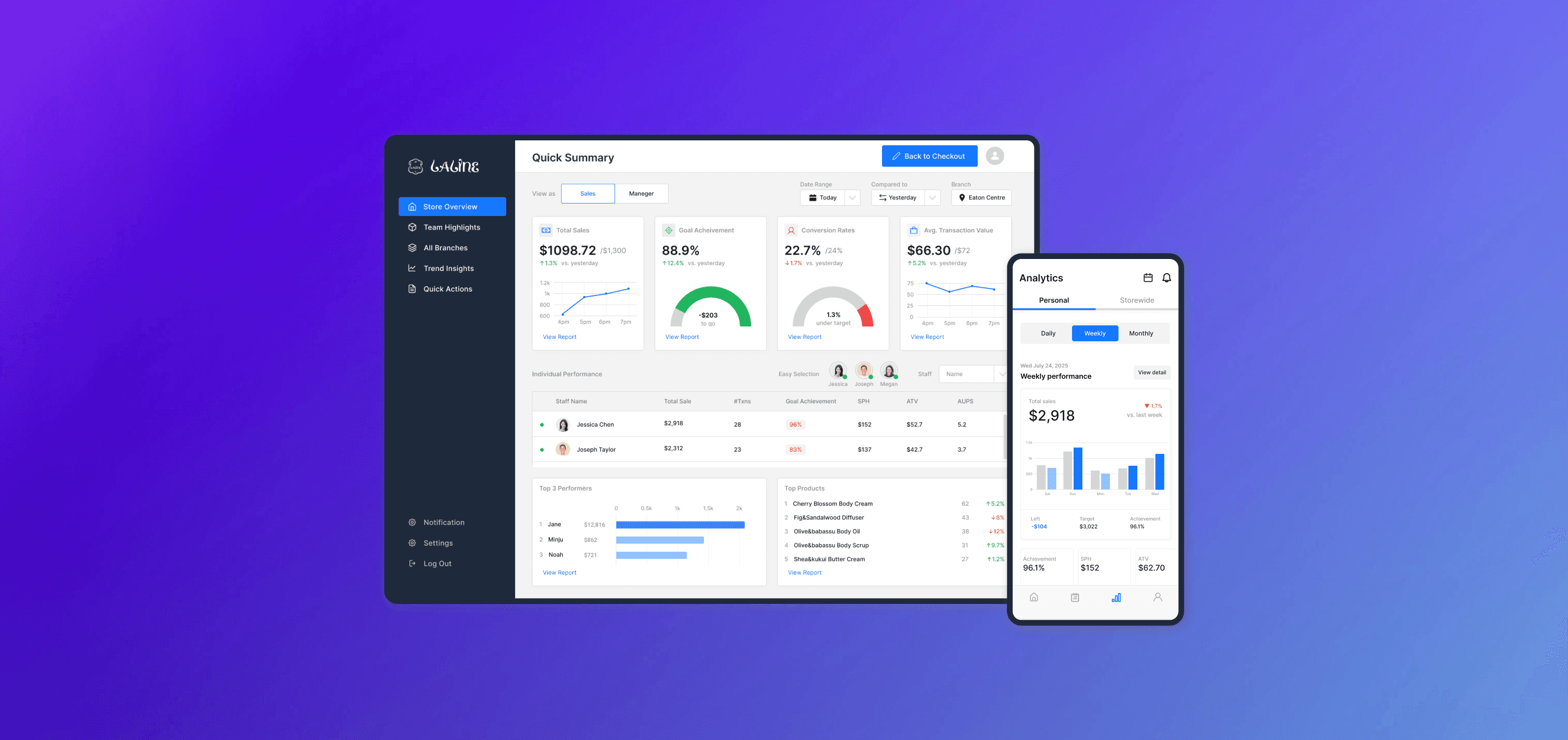
Laline's 45+ frontline staff relied on dashboards, Excel, whiteboards, WhatsApp, and paper to track sales progress — wasting 10+ hours per week on manual work.


I designed a cross-platform automated tracking dashboard that replaced this fragmented workflow with real-time, role-based progress visibility.

Laline's 45+ frontline staff relied on dashboards, Excel, whiteboards, WhatsApp, and paper to track sales progress — wasting 10+ hours per week on manual work.


I designed a cross-platform automated tracking dashboard that replaced this fragmented workflow with real-time, role-based progress visibility.

67%

Tool reduction (6 → 2)

60%

Admin time saved (1.5h → 0.5h)

92%

Usability test completion rate

Problem

Missing supportive progress tracking

Missing supportive progress tracking

In a fast-paced retail environment, sales associates need to stay aware of both individual and team progress. However, the current system presented three critical challenges:

In a fast-paced retail environment, sales associates need to stay aware of both individual and team progress. However, the current system presented three critical challenges:

01

One dashboard for 45+ staff

Each staff role has different needs, but everyone saw the same flat view with no personalization.

02

Raw data only

Only raw progress numbers without actionable context — no way to understand what the numbers mean for your shift.

03

No automated updates

Need to manually check progress each morning and evening. No reminders, no daily reports.

10+ hours/week lost on manual work with 5+ tools (dashboard, Excel, whiteboard, WhatsApp, paper) to stay aligned.

How Might We

How might we improve progress tracking efficiency to save time and keep everyone aligned with business goals?

Research

4 interviews, clear patterns

4 interviews, clear patterns

I conducted quick interviews with frontline staff and managers. With no dedicated researcher on the team, I focused on high-signal questions that would directly inform design decisions.

I conducted quick interviews with frontline staff and managers. With no dedicated researcher on the team, I focused on high-signal questions that would directly inform design decisions.

3/4

Often forgot to check progress on busy days

Need automated reminders

4/4

Struggled finding relevant info in the official dashboard

Need better information hierarchy

3/4

Could easily self-assess their own performance

Self-awareness exists — tools don't support it

4/4

Needed role-differentiated experiences

Managers vs. associates see different things

Solution
One connected system, three core features

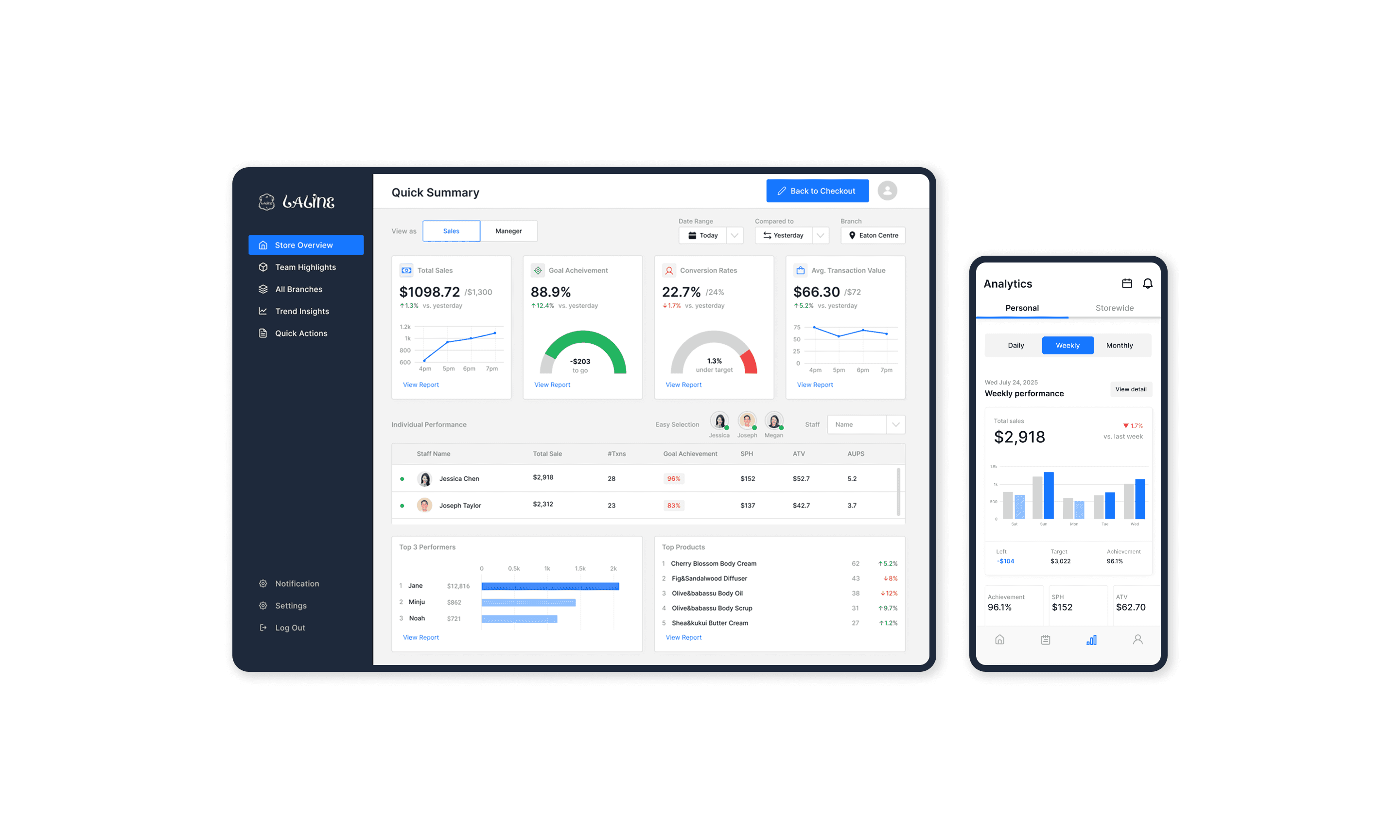
One connected system, three core features

Each feature directly maps to a research insight — addressing a specific pain point with a measurable improvement.

Each feature directly maps to a research insight — addressing a specific pain point with a measurable improvement.

Try Prototype on Figma →

01

Cross-platform

dashboard

Access live performance data anywhere — desktop for managers in the back office, mobile for associates on the floor. Real-time sync across all devices.

→ Solves: 'Can't find info' + 'Forgot to check'

02

Auto check-ins

& reporting

Automated daily reminders and generated reports replace manual WhatsApp messages and paper tracking. Zero manual overhead.

→ Solves: 'No automated updates' + '10+ hrs/week lost'

03

Role-based

personalized view

Managers see team aggregates and trends. Associates see individual targets and ranking. Same system, different contexts.

→ Solves: 'One dashboard for 45+ staff'

Usability Testing

Validating with real users

Validating with real users

We ran a usability test with 4 participants (3 sales associates, 1 assistant manager) using Maze prototypes over Google Meet to validate clarity and task efficiency.

We ran a usability test with 4 participants (3 sales associates, 1 assistant manager) using Maze prototypes over Google Meet to validate clarity and task efficiency.

Task

Success Rate

Confidence

Check remaining target for today and assess goal status

100% (4/4)

4.5 / 5

Identify underperforming KPIs from today's sales data

75% (3/4)

3.8 / 5

Complete the daily closing report

100% (4/4)

4.8 / 5

92%

92%

Task completion rate (11/12)

4.8s

4.8s

Average goal-check time

4.3/5

4.3/5

Self-rated ease of use

Expected Impact

Measurable improvements projected

Measurable improvements projected

Based on usability testing results, we estimated the potential impact if the redesigned workflow were implemented in real store operations.

Based on usability testing results, we estimated the potential impact if the redesigned workflow were implemented in real store operations.

~60%

~60%

Admin time reduction

1.5h → 0.5h per store/day

~40%

~40%

Goal check-in increase

3x → 5x per day avg.

~67%

~67%

Tool reduction

6 tools → 2 tools

Cross-Platform Prototype

Auto Check-ins Designed

Role-Based Views

Usability Validated

Reflection

What this project taught me

What this project taught me

01

One product, many users

Even within the same system, user behaviours diverge. Designing role-based views taught me that personalization isn't a feature — it's a fundamental architecture decision.

02

Problem framing shapes the solution

Internal tools aren't cheap to redesign. Matching solution depth to problem scale — and proving ROI through time-savings data — was as important as the design itself.

03

Designing a flow, not just a screen

Product designers don't design isolated screens. They shape end-to-end experiences that support decision-making across contexts, devices, and user mental models.

Areas for improvement

Involve cross-functional partners earlier for feasibility. Validate with frontline staff during active shifts — not just controlled testing — to surface real-context blind spots.